Free tool · Quebec

Heat pump vs. electric baseboards

What a heat pump would actually change on your Hydro-Québec bill — using the current Rate D prices, with every assumption visible and adjustable. The answer is a range, because the honest answer depends on your house.

Your electricity use

Use your real number if you can — the total kWh for the last 12 months is on your Hydro-Québec bill or in your Customer Space. The presets are rough starting points only.

Electric baseboards — heating
With a heat pump — heating
Estimated annual saving
Change the assumptions
Share of your electricity that goes to heating 54%
Hydro-Québec puts space heating at roughly 54% of a typical home's consumption. Lower it if you have electric hot water and a big load elsewhere.
Share of the heating load the heat pump actually carries 60%
This is the assumption most calculators hide. A wall-mounted unit heats the space it serves — bedrooms, basements and closed rooms keep running on baseboards, and below the balance point the backup takes over. One head in an open plan is nearer 50%; a well-placed multi-head system is nearer 75%.
Seasonal performance (COP) over a Montreal winter 2.4
Heat delivered per unit of electricity, averaged across the season — not the rating on the box, which is measured at mild temperatures. Hydro-Québec cites 2 to 3.5 for instantaneous COP; a seasonal average for a cold-climate unit here is lower.

Savings come off the top of your bill, not the average. A heated Quebec home is past the 40 kWh/day first-tier threshold all winter, so the kWh you stop using is normally billed at the second-tier price.

These savings assume the unit is actually clean

Every number above assumes the heat pump performs the way it was designed to. A fouled indoor coil, a blocked blower wheel or a clogged outdoor condenser makes the compressor work harder for less heat — which comes straight off the COP the whole calculation rests on. That is the part Climeo does.

Heat pump cleaning in Montreal Something already wrong? Run the diagnostic

Climeo cleans and maintains heat pumps, mini-splits and air exchangers. We do not sell or install heat pumps, and this tool is not a sales pitch for one — it is an estimate you can check.

How this is calculated

Electric baseboards convert electricity to heat at essentially 1:1. A heat pump moves heat instead of making it, so it delivers more heat than the electricity it consumes — but only for the part of your home it actually heats.

heat pump kWh = heating kWh × ( coverage ÷ COP + (1 − coverage) )

The second term is the part that stays on resistive heat. Dropping it is why a lot of online calculators show savings roughly double what Hydro-Québec itself claims.

InputValue usedSource
First tier, up to 40 kWh/day7.065 ¢/kWh Hydro-Québec Rate D, effective 2026-04-01
Remaining consumption11.142 ¢/kWh Hydro-Québec Rate D, effective 2026-04-01
System access charge46.154 ¢/day Identical either way — excluded, it cancels out
Heating share of consumption54% (adjustable) Hydro-Québec
Heat pump coverage60% (adjustable, range 50–70%) Climeo assumption — stated, not measured
Seasonal COP2.4 (adjustable, range 2.0–2.8) Within Hydro-Québec's cited COP 2–3.5

Calibration. With the defaults above the tool lands on about 35% of heating consumption and 19% of total consumption. Hydro-Québec states a heat pump can save up to 35% of heating consumption and up to 20% of total. That agreement is the check — the model was set to match a published figure rather than to produce an impressive one.

What this does not account for: the purchase and installation cost, available grants, your insulation and air-tightness, how cold the particular winter is, whether the unit is correctly sized, or the summer cooling you also get. It is an operating-energy comparison only. Treat the range as a range — if a contractor quotes you a single confident savings number, ask which coverage and seasonal COP they assumed.

What a heat pump actually does

Both diagrams are free to reuse with attribution to Climeo.
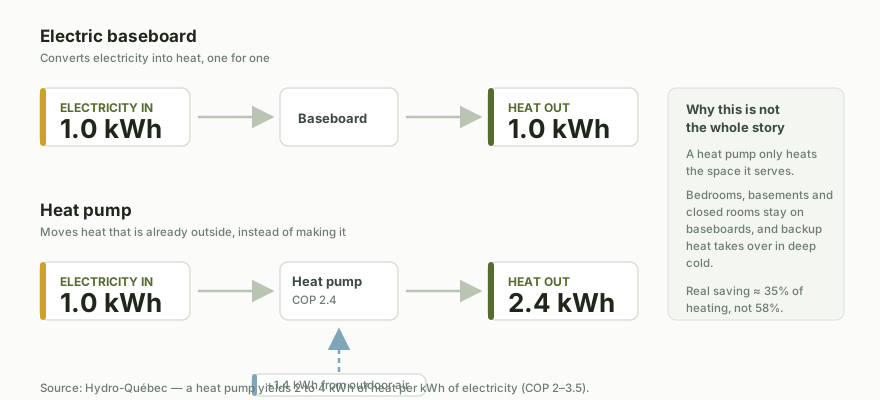
Diagram comparing energy flow: an electric baseboard turns 1 kWh of electricity into 1 kWh of heat, while a heat pump uses 1 kWh of electricity to deliver about 2.4 kWh of heat by moving 1.4 kWh in from outdoor air.
A baseboard converts electricity into heat one for one. A heat pump moves heat that is already outside, so it delivers more heat than the electricity it draws — but only for the part of the home it serves.
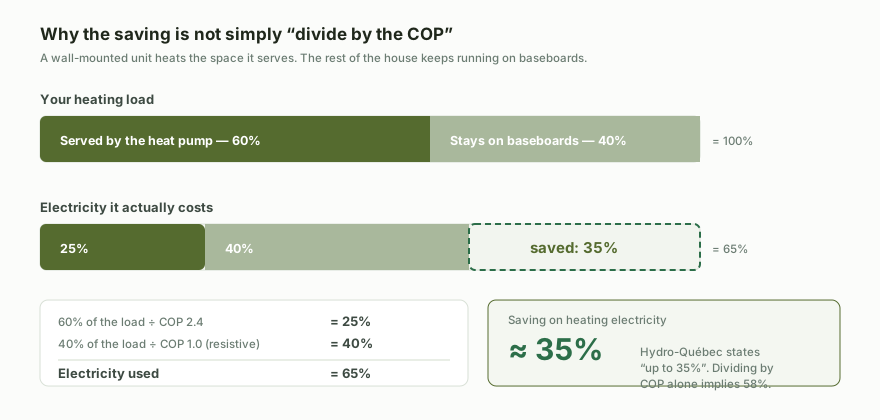
Diagram showing why savings are about 35 percent rather than 58 percent: 60 percent of the heating load runs at COP 2.4 and costs 25 percent, while 40 percent stays on baseboards and costs 40 percent, totalling 65 percent of the original electricity.
The step most calculators skip. Dividing the whole heating load by the COP implies a 58% saving; once the part that stays on baseboards is counted, the realistic figure is about 35%.

Questions people actually ask

Will a heat pump really cut my Hydro-Québec bill by two thirds?
No. A seasonal COP of 2.4 would imply 58% less heating electricity if the heat pump carried the entire heating load — but it does not. A wall-mounted unit heats the space it serves; bedrooms, basements and closed rooms stay on baseboards, and resistive backup takes over in deep cold. Once that is accounted for, the realistic saving is around 35% of heating electricity, which is also what Hydro-Québec states.
Do I still need my electric baseboards?
Yes. In Quebec a heat pump is normally installed alongside baseboards rather than replacing them. The baseboards cover the rooms the unit does not reach and act as backup when outdoor temperatures fall below the unit's effective range.
What happens when it gets very cold?
A cold-climate heat pump keeps producing heat well below freezing, but its capacity and efficiency both fall as the outdoor temperature drops. Below the balance point for your home, backup resistive heat carries part of the load — which is why a seasonal average COP is lower than the rating measured at mild temperatures.
Does this include the cost of buying and installing the unit?
No. This is an operating-energy comparison only. It does not include equipment cost, installation, financing, maintenance, or any grant you may qualify for. A payback calculation needs a real installed quote, which depends on your home.
Are government or Hydro-Québec grants included?
No. Programs such as Hydro-Québec's LogisVert can change the economics substantially, but eligibility and amounts depend on your household and equipment. Check the current program terms directly with Hydro-Québec rather than assuming a figure here.
Why does the price per kWh matter so much?
Hydro-Québec's Rate D has two tiers: a lower price for the first 40 kWh per day and a higher price for everything beyond it. Electricity you stop using comes off the top of the bill, so for a heated home the kWh saved is normally valued at the higher second-tier price, not at your average rate.
Is the daily system access charge included in the comparison?
No, and it should not be. The system access charge is the same whether you heat with baseboards or a heat pump, so it cancels out of the difference between the two options.
Does a dirty heat pump actually use more electricity?
Yes. The COP this calculation rests on assumes clean heat-exchange surfaces and unrestricted airflow. A fouled indoor coil, a blocked blower wheel or a clogged outdoor condenser forces the compressor to run longer for the same heat, which lowers the effective seasonal COP and erodes the saving shown above.

Sources

Hydro-Québec, Electricity Rates, effective 2026-04-01 — Rate D system access charge, first-tier and second-tier energy prices. Rate schedule (PDF)
Hydro-Québec, heat pump guidance — coefficient of performance of 2 to 3.5, and savings of up to 35% of heating consumption. Heat pumps
Rates change annually on 1 April. If the effective date above is not the current one, the figures on this page are out of date — tell us and we will correct it.